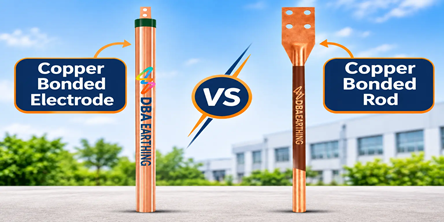
If you are comparing earthing products, you may have noticed that “copper bonded rod” and “copper bonded electrode” are often used interchangeably. In many cases, they refer to the same type of earthing component: a high-strength steel core coated with electrolytic copper to provide conductivity, corrosion resistance, and a safe path for fault current into the earth.
However, the terms are not always used with the same precision. A copper bonded rod usually describes the straight, rod-shaped earthing electrode, while copper bonded electrode can be a broader product category that includes rods, pipes, pipe-in-pipe designs, and other electrode configurations. Understanding this distinction helps you compare products accurately and choose the right solution for your project.
What Is a Copper Bonded Rod?
A copper bonded rod is a straight earthing electrode made by molecularly bonding a layer of electrolytic copper onto a high-tensile, low-carbon steel core. The steel core provides mechanical strength, while the copper layer improves conductivity and protects the rod from corrosion in the soil.
Copper bonded rods are commonly installed as earth electrodes in industrial plants, commercial buildings, solar plants, telecom sites, substations, and equipment earthing systems. They are designed to safely dissipate fault currents and lightning-related surge energy into the ground.
Main features
- Steel core for high tensile strength and easier installation
- Copper coating for conductivity and corrosion resistance
- Straight rod profile, typically driven vertically into the soil
- Suitable for a wide range of industrial and commercial earthing applications
- Often specified with a minimum copper coating thickness of 250 microns
What Is a Copper Bonded Electrode?
A copper bonded electrode is a broader term for an earthing electrode constructed with a copper-bonded conductive surface. In practice, it may be a copper bonded rod, but it can also refer to a pipe electrode, pipe-in-pipe electrode, or another engineered earthing electrode designed for specific site conditions.
Like a copper bonded rod, a copper bonded electrode uses a steel core with a bonded copper layer. The purpose remains the same: create a low-resistance connection to earth, protect people and equipment from electrical faults, and support the long-term performance of the earthing system.
Main features
- Copper-bonded steel construction
- Available in rod, pipe, and pipe-in-pipe configurations
- Designed to provide a low-resistance path for fault current
- Suitable for critical earthing applications where durability and corrosion resistance matter
- Often used with earthing backfill compound, connections, and earth pit accessories
Copper Bonded Rod vs Copper Bonded Electrode
| Aspect | Copper Bonded Rod | Copper Bonded Electrode |
| Meaning | A specific straight rod-type earthing electrode | A broader category of copper-bonded earthing electrodes |
| Common shape | Straight cylindrical rod | Rod, pipe, or pipe-in-pipe design |
| Construction | Steel core with bonded copper coating | Steel core with bonded copper coating |
| Primary function | Acts as an earth electrode | Acts as an earth electrode |
| Typical use | Direct-driven earthing installations | Site-specific earthing designs, including pipe-based systems |
| Buying consideration | Diameter, length, copper coating, tensile strength | Electrode type, dimensions, coating, application, and accessories |
In simple terms, every copper bonded rod can be called a copper bonded electrode, but not every copper bonded electrode is a rod. The difference is mainly in terminology and product configuration, not in the basic earthing principle.
Is There a Real Difference?
Yes—but it is usually a difference in product description and design, not a difference in core function.
A copper bonded rod is a type of copper bonded electrode. When a supplier uses “copper bonded electrode,” they may be referring to a rod, but they may also mean a pipe electrode or a specialised earthing electrode. Therefore, buyers should not assume that two products with different names automatically have different performance levels.
The more important question is not “rod or electrode?” but which electrode design is appropriate for your soil, installation method, and earthing requirement?
What Actually Affects Performance?
The real performance difference comes from the quality and suitability of the complete earthing system, not merely the label on the product.
Copper coating quality
A uniform copper coating helps protect the steel core from corrosion and supports stable electrical performance over time. DBA Earthing specifies copper bonded rods and electrodes with a minimum coating of 254 microns, or 10 mils, over a high-strength steel core.
Steel core strength
The steel core must be strong enough to withstand driving into compact or rocky soil without bending. High-tensile, low-carbon steel is commonly used for this purpose.
Electrode dimensions
Diameter and length influence the electrode’s contact with the soil and its ability to achieve the required earth resistance. Longer electrodes may be needed where soil resistivity is high or where deeper installation is necessary.
Installation and connections
Even a high-quality electrode will underperform if it is poorly installed or connected. Proper clamps, conductors, joints, earth pits, and periodic testing are essential for a reliable earthing system.
Which Should You Choose?
Choose a copper bonded rod when your project requires a straightforward, durable, directly driven earthing electrode. It is a strong choice for industrial plants, commercial buildings, solar installations, telecom infrastructure, and equipment earthing.
Choose a copper bonded electrode when your specification calls for a particular electrode configuration, such as a pipe electrode or pipe-in-pipe system. This may be suitable where installation conditions, soil behaviour, or project requirements call for a design beyond a standard straight rod.
How DBA Earthing Can Help
DBA Earthing manufactures and supplies both copper bonded rods and copper bonded electrodes for industrial, commercial, infrastructure, renewable energy, and electrical safety applications. Their products are designed with a high-strength steel core, electrolytic copper bonding, and corrosion-resistant construction.
If you are unsure whether your project needs a copper bonded rod or another type of copper bonded electrode, DBA Earthing can help you assess the site conditions and select the most suitable earthing solution.