
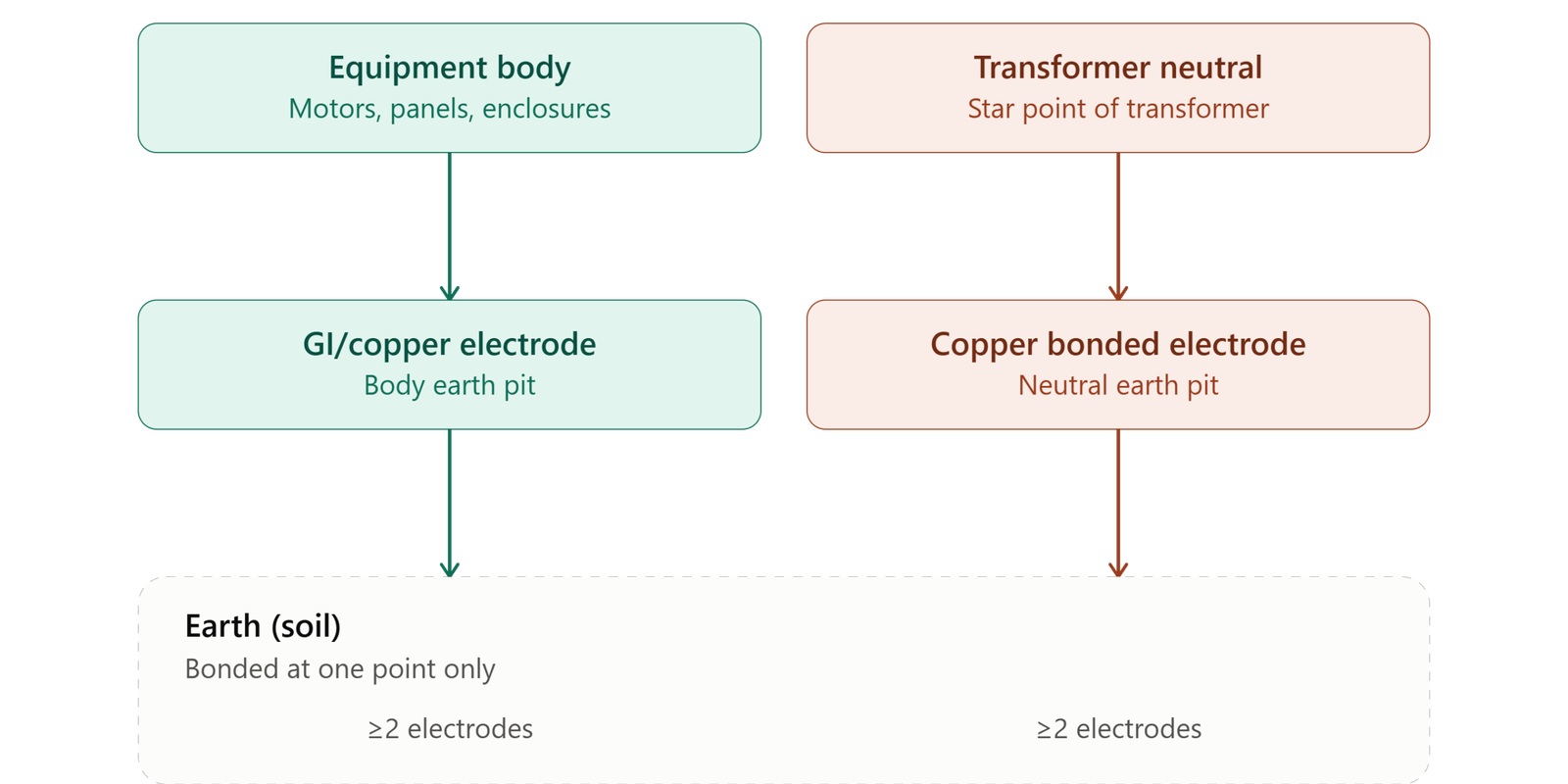
If you’ve ever stood in front of a distribution panel and wondered why there are separate earth pits for the equipment body and the transformer neutral, you’re not alone. “Body earthing” and “neutral earthing” get used interchangeably on site — and that confusion is exactly how unsafe installations happen.
They are not the same thing. They don’t serve the same purpose, they’re not supposed to be connected at multiple points, and mixing them up in a design can cost you an IS 3043 compliance failure or, worse, a life. This guide breaks down exactly where they differ, why both exist, and which earthing electrode to use for each.
What Is Body (Equipment) Earthing?
Body earthing — also called equipment earthing — is the connection between the non-current-carrying metal parts of electrical equipment (motor frames, panel bodies, transformer tanks, DB enclosures) and the earth.
Under normal conditions, no current flows through this connection at all. It exists purely as a safety path. If insulation fails inside the equipment and the live wire touches the metal casing, body earthing gives that fault current a low-resistance route to the ground instead of through a person who touches the casing. This is what protects site staff from electric shock and lets protective devices (MCBs, ELCBs, fuses) trip fast enough to isolate the fault.
Key point: body earthing is about human safety and equipment protection, not normal circuit operation.
What Is Neutral Earthing?
Neutral earthing (also called system earthing) is the connection between the neutral point of the electrical system, usually the star point of a transformer or generator, and the earth.
Unlike body earthing, this connection does carry current under normal operating conditions. It stabilizes system voltage, provides a reference (zero) potential for the network, and gives unbalanced load current a return path. Without a properly earthed neutral, voltage on healthy phases can rise dangerously during a fault, damaging equipment across the entire installation.
Key point: neutral earthing is about system stability and fault current management, not personal shock protection.
Body Earthing vs Neutral Earthing: Side-by-Side Comparison
| Parameter | Body / Equipment Earthing | Neutral Earthing |
| What it connects | Metal body/enclosure of equipment | Neutral point of transformer/generator |
| Purpose | Protects personnel from shock | Protects system stability, manages fault current |
| Current under normal conditions | None (fault path only) | Carries unbalanced/return current |
| Potential | Always at earth potential (0V) | Can rise during fault conditions |
| Governing clause | IS 3043 – equipment earthing | IS 3043 – system/neutral earthing |
| Typical electrode used | GI pipe earthing electrode, copper bonded electrode | Copper bonded electrode, pure copper electrode (for critical installations) |
| Number of earth pits required (IS 3043) | Minimum 2, independent of neutral pits | Minimum 2, independent of body pits |
Why They Must Never Share the Same Earth Pit
IS 3043, the Indian Standard Code of Practice for Earthing, is explicit on this: body/equipment earthing and neutral earthing each require their own set of at least two independent earth electrodes. They should only meet at one defined point — typically the main earthing bus bar, and nowhere else downstream.
Why the separation matters on real sites:
- Fault current isolation – if a system fault raises the neutral’s potential, an interconnected body earth would raise the equipment casing’s potential too, defeating the entire purpose of body earthing.
- Avoiding ground loops – multiple bonding points between neutral and body earth create circulating currents that interfere with sensitive equipment and instrumentation.
- Selective tripping – separate paths let protective devices distinguish between a system imbalance and a genuine body-fault, so the right breaker trips instead of the whole installation going down.
If you’re planning a new industrial earthing layout, our earthing installation service is designed around exactly this separation — independent electrode groups for body and neutral, tested and documented to IS 3043 before handover.
Choosing the Right Electrode for Each
This is where most site confusion actually costs money — using the wrong electrode type for the application.
- GI pipe earthing electrodes – cost-effective, widely used for equipment/body earthing in general industrial and commercial installations where soil corrosivity is moderate.
- Copper bonded earthing electrodes – higher conductivity and longer life; the preferred choice for neutral earthing on transformers, generators, and critical infrastructure where earth resistance values must stay consistently low.
- Pure copper earthing electrodes – used where maximum conductivity and corrosion resistance are non-negotiable, such as substations, telecom towers, and power generation sites.
- Chemical earthing electrodes – ideal for both body and neutral earthing in high-resistivity soil (rocky or sandy terrain), since the backfill compound around the electrode keeps resistance low year-round.
Browse the full range of GI pipe and copper bonded earthing electrodes to match the right type to your soil condition and application.
Common Mistakes Site Engineers Make
- Treating “earthing” and “neutral” as interchangeable terms on drawings, leading to incorrect bonding.
- Using a single earth pit for both body and system neutral to save cost — a direct IS 3043 violation.
- Skipping periodic earth resistance testing, so a degraded pit goes unnoticed until a fault occurs.
- Using undersized or bare GI electrodes in high-moisture or industrial-effluent soil, where copper bonded or chemical electrodes would last significantly longer.
Not sure if your existing installation is compliant? Our earth resistance testing service checks pit-by-pit values against IS 3043 limits and flags exactly where remedial work is needed.
Ideal Earth Resistance Values
| Application | Recommended Earth Resistance |
| Domestic/commercial body earthing | Below 5 ohms |
| Industrial equipment earthing | Below 2 ohms |
| Neutral earthing (transformers/generators) | Below 1 ohm |
| Sensitive/critical installations (data centers, telecom) | Below 0.5 ohm |
Lower values mean fault current finds an easier path to ground — the safety margin improves accordingly.
FAQs
Is body earthing and equipment earthing the same thing?
Yes, “body earthing” and “equipment earthing” refer to the same concept — connecting the non-current-carrying metal parts of equipment to earth for safety.
Can neutral and earth be connected at the socket level?
No. Neutral and earth should only be bonded at one defined point (typically the main distribution board), never repeatedly downstream, or you risk creating ground loops and shock hazards.
Which electrode is better for neutral earthing, GI or copper?
Copper bonded or pure copper electrodes are generally preferred for neutral earthing because of their superior conductivity and long-term corrosion resistance, especially for transformers and generators.
How often should earthing be tested?
IS 3043 and good practice recommend annual earth resistance testing, or more frequently in corrosive/high-moisture soil conditions.
What happens if body and neutral earthing are wrongly interconnected?
A fault on the system side can raise the potential of equipment bodies that should have stayed at zero volts, putting anyone touching that equipment at risk of shock.