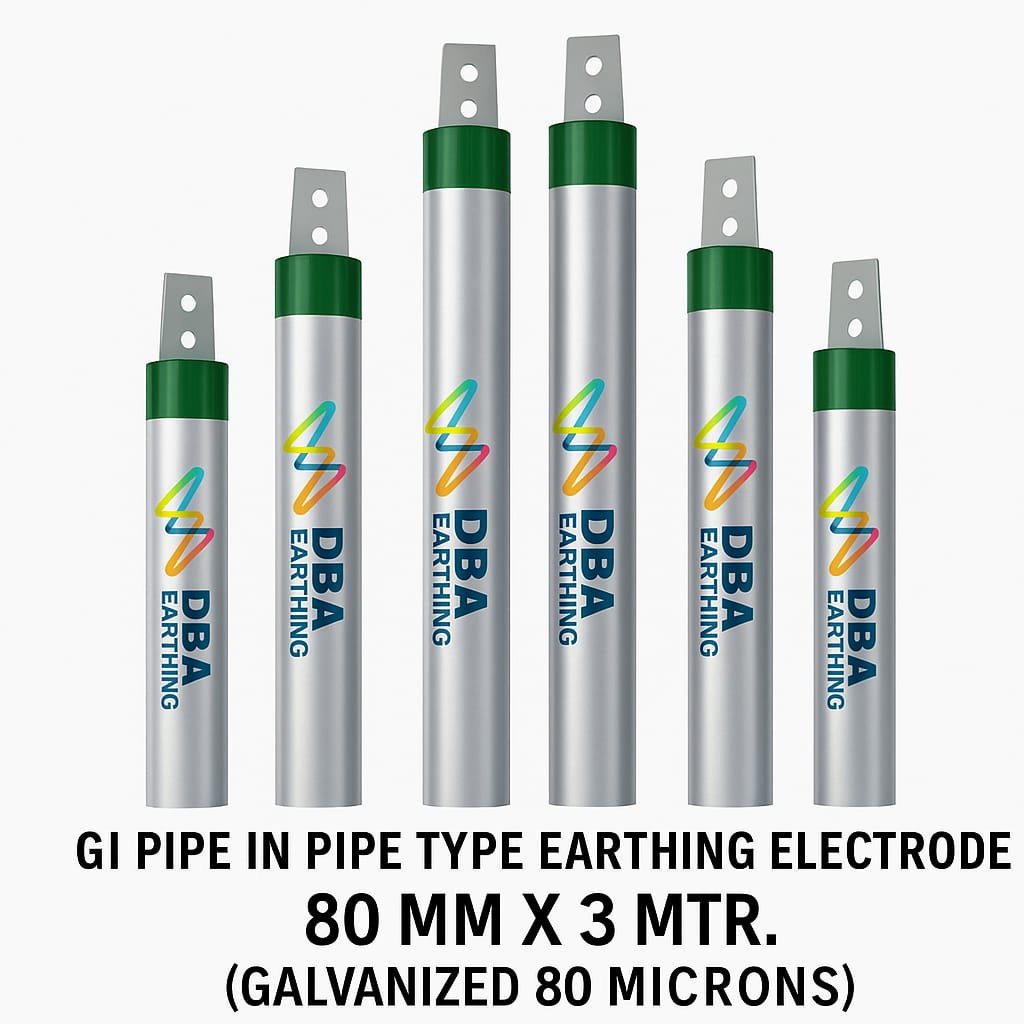
DBA Earthing is India’s No.1 GI Earthing Electrode manufacturer in Mumbai, delivering CPRI-tested, IS 3043-compliant earthing solutions since 10 years. Our GI Earthing Electrode uses hot-dip galvanized iron with 80–100 micron zinc coating, giving it a service life of 10–15 years even in high-moisture or corrosive soil.
As a leading GI Earthing Electrode supplier, we manufacture electrodes in 40mm, 50mm, 76mm, and 80mm diameters, in 1, 2, and 3-meter lengths, custom-built to match your project’s earth resistance requirements. Whether it’s a residential building or a large industrial substation, our electrodes meet both national and international earthing safety standards.
WHAT IS A GI EARTHING ELECTRODE?
A GI Earthing Electrode (galvanized iron earthing electrode, also called a GI pipe earthing electrode) is a grounding rod that provides a safe, low-resistance path for fault current to dissipate into the earth, protecting people and equipment from electrical hazards.
The electrode is manufactured from mild steel pipe that undergoes hot-dip galvanization, depositing a protective zinc layer of 80–100 microns on the surface. This zinc coating:
- Slows down corrosion by acting as a sacrificial layer
- Maintains stable earth resistance (typically 1–5 ohms, depending on soil type and backfill compound used)
- Extends the electrode’s working life to 10–15 years
The pipe is perforated along its length so moisture and soil-enhancing backfill compound can penetrate the electrode, keeping resistance low even in dry, rocky, or sandy soil conditions.
At DBA Earthing, every GI electrode is manufactured to comply with IS 3043 and is available with CPRI test certification on request.
GI EARTHING ELECTRODE — SPECIFICATIONS & SIZES
| Model No. | Diameter | Length | Zinc Coating | Thickness | Application |
| GI-EE-001-40 | 40 mm | 1 / 2 / 3 mtr | 80–100 microns | 3.5 mm | Residential, small commercial |
| GI-EE-001-50 | 50 mm | 1 / 2 / 3 mtr | 80–100 microns | 4 mm | Commercial buildings, telecom towers |
| GI-EE-001-76 | 76 mm | 1 / 2 / 3 mtr | 100 microns | 4.5 mm | Industrial plants, substations |
| GI-EE-001-80 | 80 mm | 1 / 2 / 3 mtr | 100 microns | 5 mm | Heavy industrial, data centers |
Custom diameters and lengths available on request. Minimum Order Quantity: 10.
Standard compliance: IS 3043:2018 | Material: Hot-dip galvanized mild steel | Country of Origin: Made in India
BENEFITS OF USING GI EARTHING ELECTRODES
- Corrosion Resistance: The 80–100 micron hot-dip galvanized zinc coating protects the electrode from rust, extending its life to 10–15 years even in humid or coastal environments.
- Stable Low Resistance: Maintains earth resistance in the 1–5 ohm range, keeping electrical hazards to a minimum regardless of seasonal soil moisture changes.
- Cost-Effective: Up to 40–50% more affordable than copper or copper-bonded alternatives, without compromising on safety performance for standard applications.
- Easy Installation: Lightweight yet strong pipe construction allows fast, low-labor installation across varied site conditions — typically installed within 2–4 hours per pit.
- Enhanced Safety: Efficient fault current dissipation prevents electric shock, equipment damage, and fire hazards in residential, commercial, and industrial electrical systems.
FEATURES & APPLICATIONS OF GI EARTHING ELECTRODE
Several important features come with our GI Earthing Electrode:
- Made of high-quality galvanised iron
- Surface that won’t rust for a longer life
- Consistent thickness for consistent performance
- Perforated design lets more moisture and soil come into contact with it.
- Simple to set up and keep up
- Works with all kinds of soil
Contractors, engineers, and businesses looking for reliable earthing solutions choose our electrodes because of these features.
Frequently Asked Questions (FAQs)
Q1. What is the lifespan of a GI Earthing Electrode?
A GI Earthing Electrode typically lasts 10–15 years or more, depending on soil conditions and installation quality, thanks to its corrosion-resistant galvanised coating.
Q2. Can GI Earthing Electrodes be used in rocky or dry soil?
Yes! Perforated designs and backfilling compounds help maintain low resistance, even in challenging soil conditions.
Q3. Are GI Earthing Electrodes better than copper electrodes?
While copper offers slightly better conductivity, GI electrodes are far more cost-effective and still deliver excellent performance, making them suitable for most applications.
Q4. What standards do DBA Earthing’s GI electrodes comply with?
Our electrodes comply with IS 3043 and other national and international electrical safety standards.
Q5. Can DBA Earthing supply custom sizes of GI Earthing Electrodes?
Absolutely! As a flexible GI Earthing Electrode Manufacturer in Mumbai, we customise electrode sizes and specifications to meet client requirements.
Q6. What is the earth resistance value of a GI Earthing Electrode?
A properly installed GI Earthing Electrode with backfill compound typically achieves an earth resistance of 1–5 ohms, depending on soil type, moisture, and electrode depth.
Q7. What is the zinc coating thickness on your GI Earthing Electrode?
Our GI electrodes carry a hot-dip galvanized zinc coating of 80–100 microns, as per IS 2629 and IS 3043 guidelines, which directly determines corrosion resistance and service life.
Q8. What sizes of GI Earthing Electrode do you manufacture?
We manufacture GI Earthing Electrodes in 40mm, 50mm, 76mm, and 80mm diameters, in 1, 2, and 3-meter lengths, with custom sizing available for bulk industrial orders.
Q9. How is a GI Earthing Electrode installed?
The electrode is vertically driven or lowered into an augured earth pit (typically 3 meters deep), surrounded by earthing backfill compound to maintain moisture and conductivity, then connected via a GI or copper earthing strip to the electrical system.
Q10. What is the difference between GI Earthing Electrode and Copper Bonded Electrode?
GI electrodes are more cost-effective and suit standard residential/commercial use with a 10–15 year life, while Copper Bonded Electrodes cost more but offer 20+ years of life and higher conductivity — better suited for telecom, data centers, and critical industrial sites.