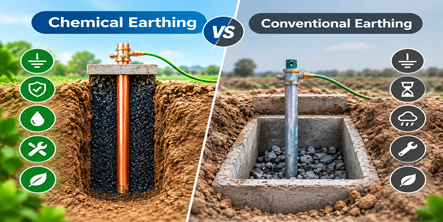
Choosing the right earthing system is not only about price. It decides how safely fault current, leakage current, and lightning-related surges are discharged into the ground. Chemical earthing is generally better for long-term stability and low maintenance, while conventional earthing can still be suitable where soil conditions are good and the initial budget is limited.
| Factor | Conventional Earthing | Chemical Earthing |
| Main electrode | GI/copper pipe or plate | GI, copper, or copper bonded electrode |
| Backfill material | Salt and charcoal | Conductive backfill compound |
| Moisture retention | Depends on watering and soil conditions | Better moisture retention around the electrode |
| Maintenance | Requires periodic watering and checking | Low maintenance in normal conditions |
| Earth resistance | Can rise as salt washes away | More stable over time |
| Corrosion risk | Higher, especially with salt-based backfill | Lower when quality materials are used |
| Initial cost | Lower | Higher |
| Long-term cost | Can increase due to maintenance | Usually more cost-effective over time |
| Best for | Good soil, low-criticality installations | Dry, rocky, sandy, or high-resistance soil |
The biggest practical difference appears after installation. A conventional pit may perform well initially, but its resistance can increase during dry weather as moisture and salt reduce around the electrode. A properly installed chemical earthing system is designed to maintain better conductivity with less routine attention.
What Is Conventional Earthing?
Conventional earthing is the traditional method of grounding an electrical system. It usually uses a GI pipe, copper plate, or GI plate buried in the soil. The electrode is surrounded by materials such as salt and charcoal to improve conductivity and retain moisture.
When an electrical fault occurs, the earthing system provides a low-resistance path for the current to flow safely into the earth. This helps protect people from electric shock and reduces the risk of damage to electrical equipment.
Conventional earthing is still widely used because it is simple and affordable. However, its performance depends heavily on soil moisture, salt content, and regular upkeep. Competitor comparisons also note that salt can leach away over time, increasing earth resistance and requiring periodic watering or recharging.
What Is Chemical Earthing?
Chemical earthing, also called maintenance-free earthing, uses a metallic electrode along with a specially formulated backfill compound. This compound is placed around the electrode to improve soil conductivity, retain moisture, and reduce corrosion.
Instead of depending on salt and charcoal, chemical earthing uses materials such as bentonite, graphite-based compounds, or other conductive backfill compounds. These help maintain a stable low-resistance path around the electrode for a longer period.
DBA Earthing provides chemical earthing solutions along with GI earthing electrodes, copper earthing electrodes, and copper bonded electrodes for residential, industrial, and infrastructure projects.
The biggest practical difference appears after installation. A conventional pit may perform well initially, but its resistance can increase during dry weather as moisture and salt reduce around the electrode. A properly installed chemical earthing system is designed to maintain better conductivity with less routine attention.
Why Conventional Earthing Needs More Maintenance
Soil does not conduct electricity as well when it becomes dry. In conventional earthing, salt and charcoal are used to create a conductive zone around the electrode. But salt is water-soluble, so rainwater and groundwater movement can gradually wash it away.
As a result, the earthing pit may need:
- Regular watering, especially in summer
- Re-salting or recharging
- Periodic resistance testing
- Replacement if the electrode corrodes
This does not mean conventional earthing is bad. It can be a practical option for small installations where the soil remains moist and maintenance is easy. However, for critical equipment, frequent maintenance can become inconvenient and costly.
Why Chemical Earthing Performs Better Long Term
Chemical earthing uses a conductive compound around the electrode to create a stable earthing zone. A good backfill compound helps retain moisture and reduces the impact of seasonal changes in soil resistance.
This makes chemical earthing especially useful for:
- Homes and apartments
- Commercial buildings
- Factories and manufacturing plants
- Solar power plants
- Telecom towers
- Data centres
- Hospitals
- Petrol pumps
- substations and industrial panels
For sites with rocky soil, sandy soil, high soil resistivity, or limited access for maintenance, chemical earthing is often the more dependable choice.
Which Earthing Is Best for Homes?
For most homes, the right choice depends on soil condition and safety requirements.
Conventional earthing may be suitable if:
- The soil is naturally moist
- The electrical load is limited
- The earth pit is easy to access
- The owner can perform periodic maintenance
Chemical earthing is usually better if:
- The soil is dry, rocky, or sandy
- The property has inverters, solar panels, or sensitive electronics
- You want lower maintenance
- The installation is in a location where watering the pit is difficult
- You want more stable earthing performance throughout the year
For a modern home with appliances, inverters, CCTV systems, and solar equipment, chemical earthing is often a safer long-term investment.
Which Earthing Is Best for Industries?
Industrial and commercial sites usually need a more reliable earthing system because they handle higher loads, machinery, control panels, and sometimes lightning protection requirements.
Chemical earthing is generally preferred for:
- Manufacturing units
- Warehouses
- Solar plants
- Data centres
- Telecom infrastructure
- Hospitals
- Commercial complexes
- substations and high-load installations
A copper bonded electrode is commonly used where durability and conductivity are important. You can explore DBA’s copper bonded electrode for applications that require low maintenance and stable performance.
For sites where copper is preferred due to its conductivity and corrosion resistance, copper earthing electrodes are suitable for demanding soil and industrial conditions.
Is Chemical Earthing Really Maintenance-Free?
Chemical earthing is often called maintenance-free, but it is more accurate to say it is low-maintenance.
A quality chemical earthing system reduces the need for:
- Frequent watering
- Salt recharging
- Frequent manual intervention
However, periodic testing is still important. Earth resistance should be checked after installation and at regular intervals, especially before monsoon or after major electrical upgrades. Even the best earthing system needs verification to confirm that it is working properly.
Common Mistakes to Avoid
Many earthing problems do not come from the type of earthing alone. They come from poor installation or low-quality materials.
Avoid these mistakes:
- Using poor-quality backfill compound
- Installing an electrode without checking soil resistivity
- Ignoring proper electrode depth
- Using loose or corroded connections
- Skipping earth resistance testing
- Choosing electrode material only on the basis of price
- Assuming chemical earthing never needs inspection
A good earthing system needs the right electrode, proper backfill, secure connections, and regular testing.
Final Verdict: Chemical Earthing or Conventional Earthing?
Choose conventional earthing if the soil is good, the load is small, and periodic maintenance is convenient.
Choose chemical earthing if you want stable resistance, lower maintenance, better performance in difficult soil, and long-term reliability.
For most modern residential, commercial, and industrial projects, chemical earthing is the better long-term choice. It offers improved conductivity, reduced maintenance, and dependable protection for electrical systems.
If you are planning an earthing installation and need guidance on electrode selection, backfill compound, or system design, DBA Earthing can help you choose the right solution for your site.